

Backups
Daily backups, 7-day retention, manual pg_dump backups, and point-in-time recovery to protect and restore your PostgreSQL data.
backups restore recovery pg_dump point-in-time recovery PITR data protection disaster recoveryEvery Pro and Team project comes with daily backups and 7 days retention. This means your data is automatically saved every day, and you can restore from any backup taken in the last week.
Free projects do not have daily backups, but you can create manual backups whenever you need them utilizing the connection string and backup tools like pg_dump.
In addition, for projects with critical data or those requiring precise recovery control, we offer point-in-time recovery as an add-on. This feature continuously backs up your data and lets you restore your database to any specific moment. It’s ideal for applications where every transaction matters and you need the ability to recover from any point in time, not just daily backups.
Something important to note is that backups don’t include your storage files. A backup will include all of your files metadata and permissions but not the files themselves. Similarly, Run services’ data (if any) is not included in our managed backups.
For details visit the pricing page
Daily Backups
Section titled “Daily Backups”All Pro and Team projects come with daily backups enabled with a 7-day retention by default. You can view, download and restore your project’s backups by visiting the Backups section in your project’s dashboard.
Restoring a Backup
Section titled “Restoring a Backup”To restore a backup, go to the Backups section in your project’s dashboard, pick the backup you want to restore from and click on “Restore”. Keep in mind this will wipe out all of the project’s data prior to initiating the restore.
Restoring a Backup on a Different Nhost Project
Section titled “Restoring a Backup on a Different Nhost Project”You can restore a daily backup directly onto another Nhost project from the dashboard, without downloading it. The source and target projects must be in the same organization and region.
- Go to the target project’s Backups section and open the “Import Backup” tab.
- Select the source project you want to import a backup from. Only projects in the same organization and region are listed.
- The source project’s daily backups are listed. Pick the backup you want and click “Import backup”.
This triggers the restore in the background. You can follow the progress in the target project’s logs by filtering on “Service: Backup Jobs”.
Restoring a Backup Locally or to an External Database
Section titled “Restoring a Backup Locally or to an External Database”You can also restore a backup to a database running locally (or any external PostgreSQL) by downloading it and restoring it manually:
Download the backup and uncompress it
Section titled “Download the backup and uncompress it”- Go to the Backups section in your project’s dashboard and download the backup you want.
- Uncompress it with
unzipor similar tool - You should see two files
globals.sqlanddatabase.custom
For instance:
$ unzip a857e914-7553-4f87-8be2-47fa365a1cb8 Archive: a857e914-7553-4f87-8be2-47fa365a1cb8 inflating: globals.sql extracting: database.customRestore global objects
Section titled “Restore global objects”Global database objects (i.e. roles) are stored in the file globals.sql, you can restore those objects with psql:
$ psql postgres://postgres:postgres@localhost:5432/local -f globals.sql SET SET SET DETAIL: owner of schema auth owner of schema storage owner of schema pgbouncer DETAIL: privileges for schema hdb_catalog privileges for schema auth owner of default privileges on new relations belonging to role nhost_auth_admin in schema auth ...Restore the database
Section titled “Restore the database”Finally, you can restore your database using pg_restore:
  ### We have no data initially  $ psql postgres://postgres:postgres@localhost:5432/local -c "SELECT COUNT(*) FROM auth.users"   count  -------       0  (1 row)
  $ pg_restore -d postgres://postgres:postgres@localhost:5432/local database.custom --clean --if-exists  pg_restore: error: could not execute query: ERROR:  relation "pg_catalog.pg_ident_file_mappings" does not exist  Command was: GRANT SELECT ON TABLE pg_catalog.pg_ident_file_mappings TO nhost_hasura;

  pg_restore: error: could not execute query: ERROR:  relation "pg_catalog.pg_parameter_acl" does not exist  Command was: GRANT SELECT ON TABLE pg_catalog.pg_parameter_acl TO nhost_hasura;

  pg_restore: error: could not execute query: ERROR:  relation "pg_catalog.pg_publication_namespace" does not exist  Command was: GRANT SELECT ON TABLE pg_catalog.pg_publication_namespace TO nhost_hasura;

  pg_restore: error: could not execute query: ERROR:  relation "pg_catalog.pg_stat_io" does not exist  Command was: GRANT SELECT ON TABLE pg_catalog.pg_stat_io TO nhost_hasura;

  pg_restore: error: could not execute query: ERROR:  relation "pg_catalog.pg_stat_recovery_prefetch" does not exist  Command was: GRANT SELECT ON TABLE pg_catalog.pg_stat_recovery_prefetch TO nhost_hasura;

  pg_restore: error: could not execute query: ERROR:  relation "pg_catalog.pg_stat_subscription_stats" does not exist  Command was: GRANT SELECT ON TABLE pg_catalog.pg_stat_subscription_stats TO nhost_hasura;

  pg_restore: warning: errors ignored on restore: 6
### Now we do have data $ psql postgres://postgres:postgres@localhost:5432/local -c "SELECT COUNT(*) FROM auth.users" count ------- 247 (1 row)Point-in-Time Recovery
Section titled “Point-in-Time Recovery”Projects with Point-in-Time Recovery enabled have their data continuously backed up, not bound to a specific schedule. You can recover to almost any point in time within your retention period. We perform a daily base backup and then capture database changes every 16MB or 5 minutes (whichever occurs first). This ensures that even your most recent data is safe and can be recovered.
Point-in-Time Recovery is an add-on and not included in the base price. For details visit the pricing page. When Point-in-Time Recovery is enabled, daily backups are disabled.
Configuring Point-in-Time Recovery
Section titled “Configuring Point-in-Time Recovery”You can configure Point-in-Time Recovery via the dashboard or using your nhost.toml:
- Go to the Backups section in your project’s dashboard.
- Enable “Point-in-Time Recovery”
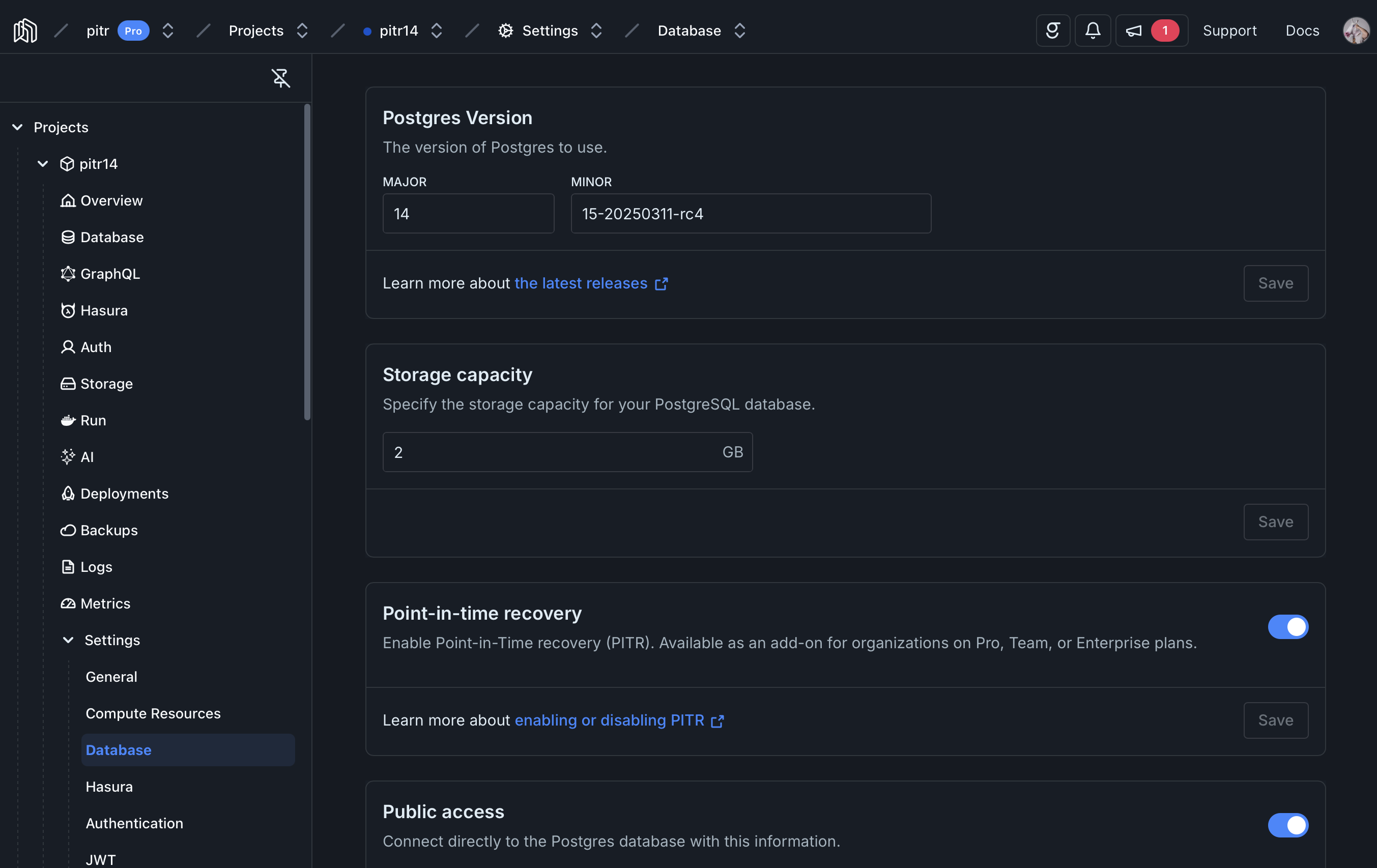
Add the following to your nhost.toml:
[postgres.pitr]retention = 7Restoring to a Specific Point in Time
Section titled “Restoring to a Specific Point in Time”To restore to a specific point in time:
Go to the Backups section in your project’s dashboard and click on “Start Restore”
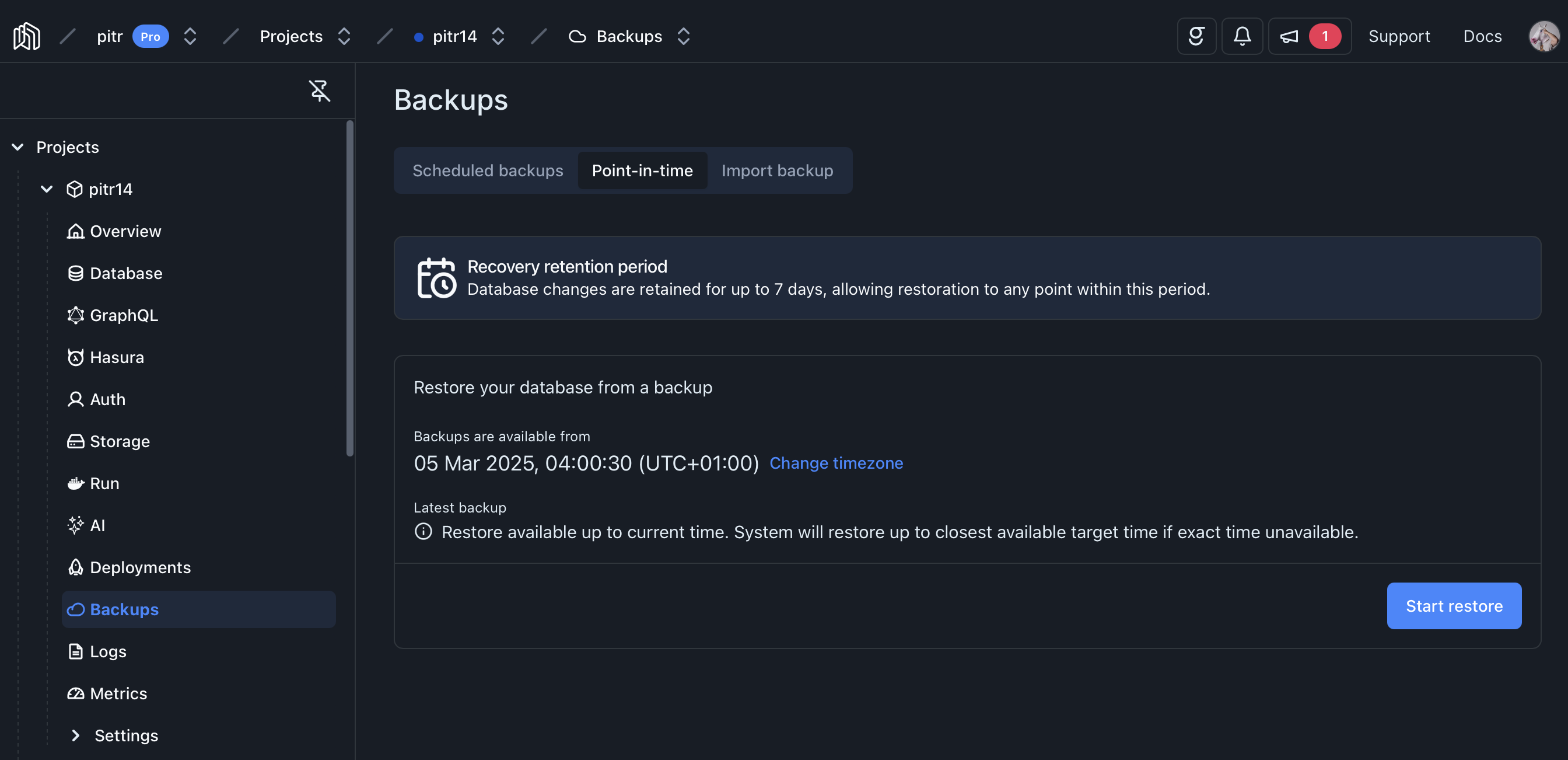
Select a point in time
Section titled “Select a point in time”Here you can click on the calendar icon to select the restore time:
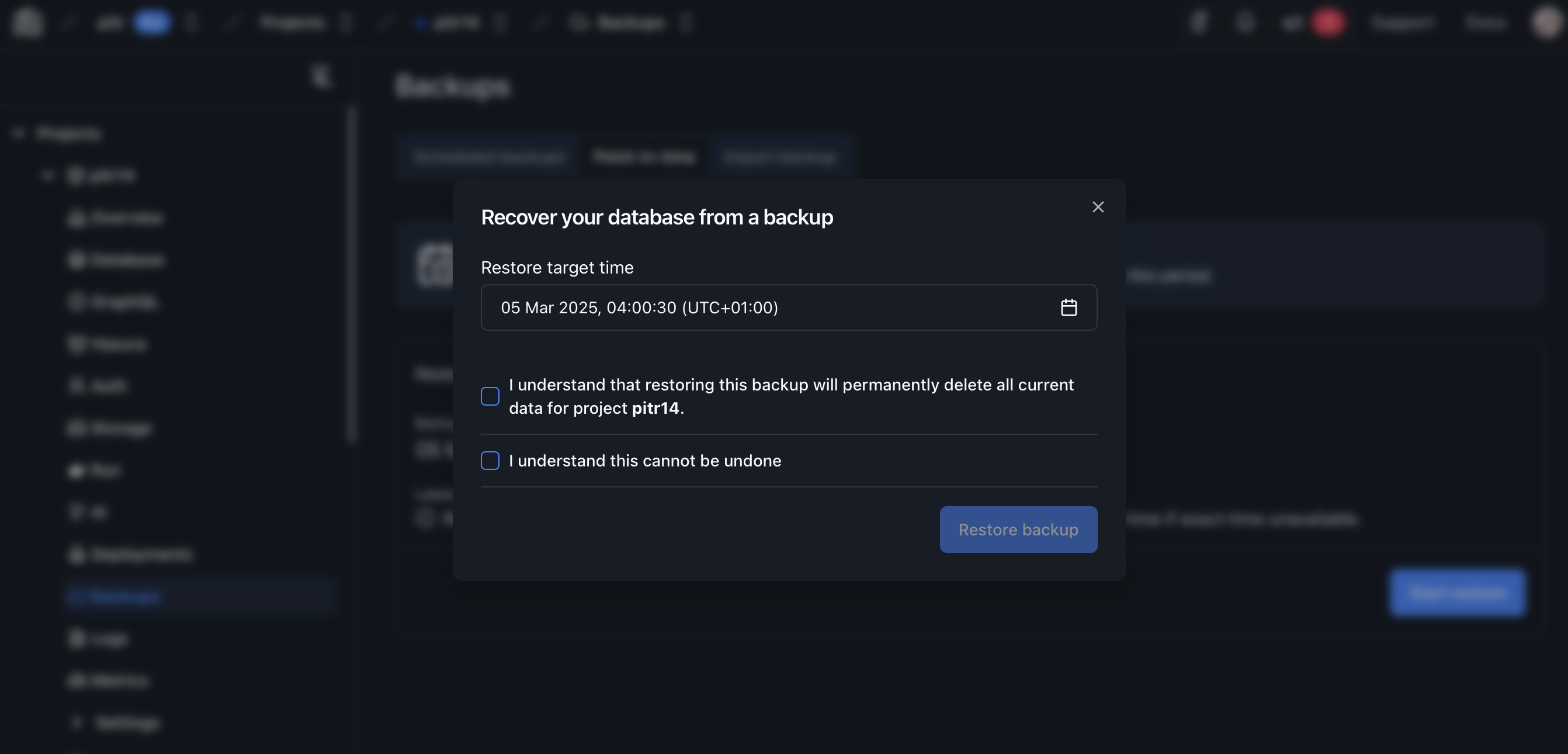
Select the time you want to restore to and click on “Select”. Be mindfule of timezones.
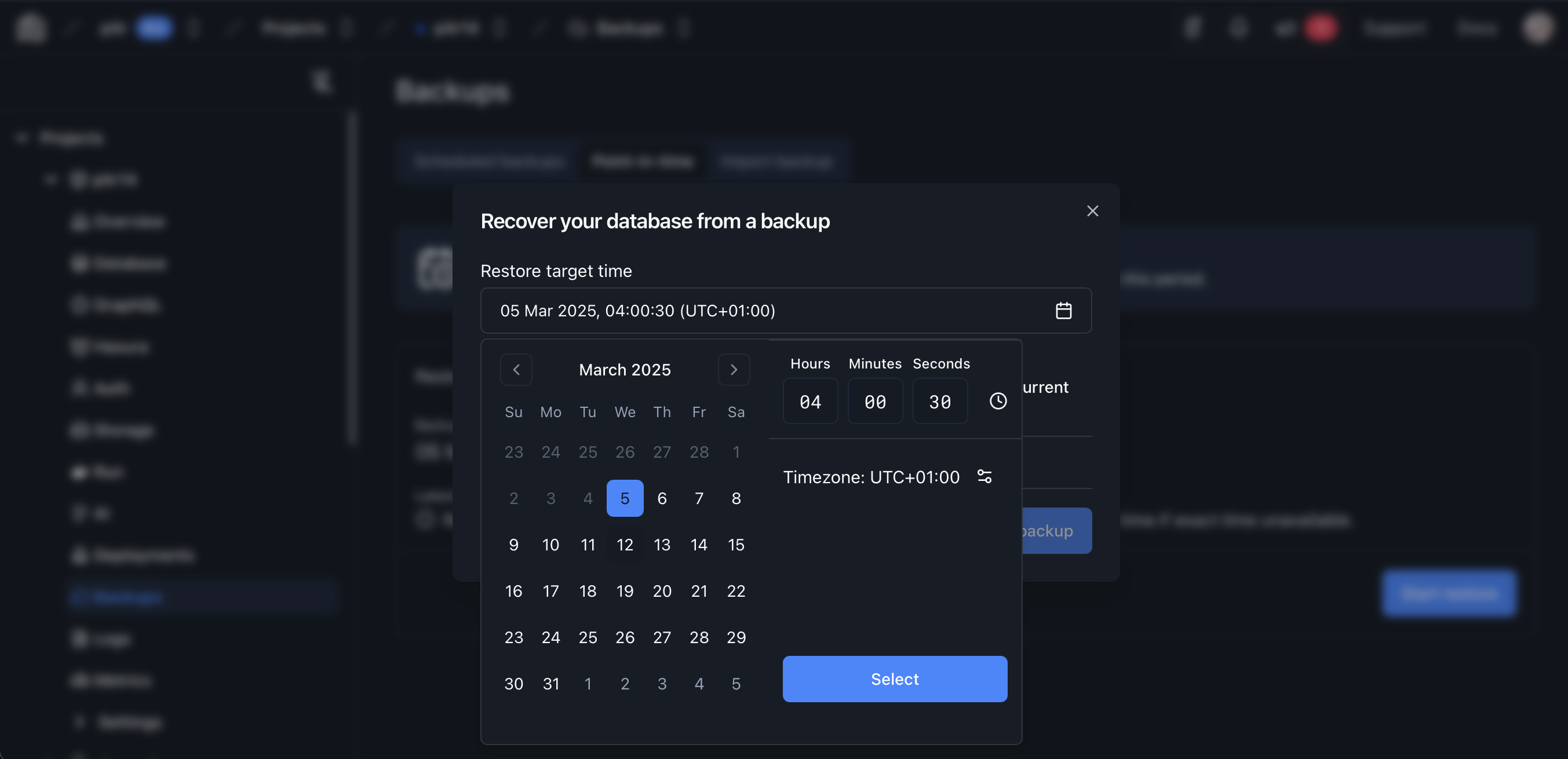
Finally, acknowledge the warning and click on “Restore”
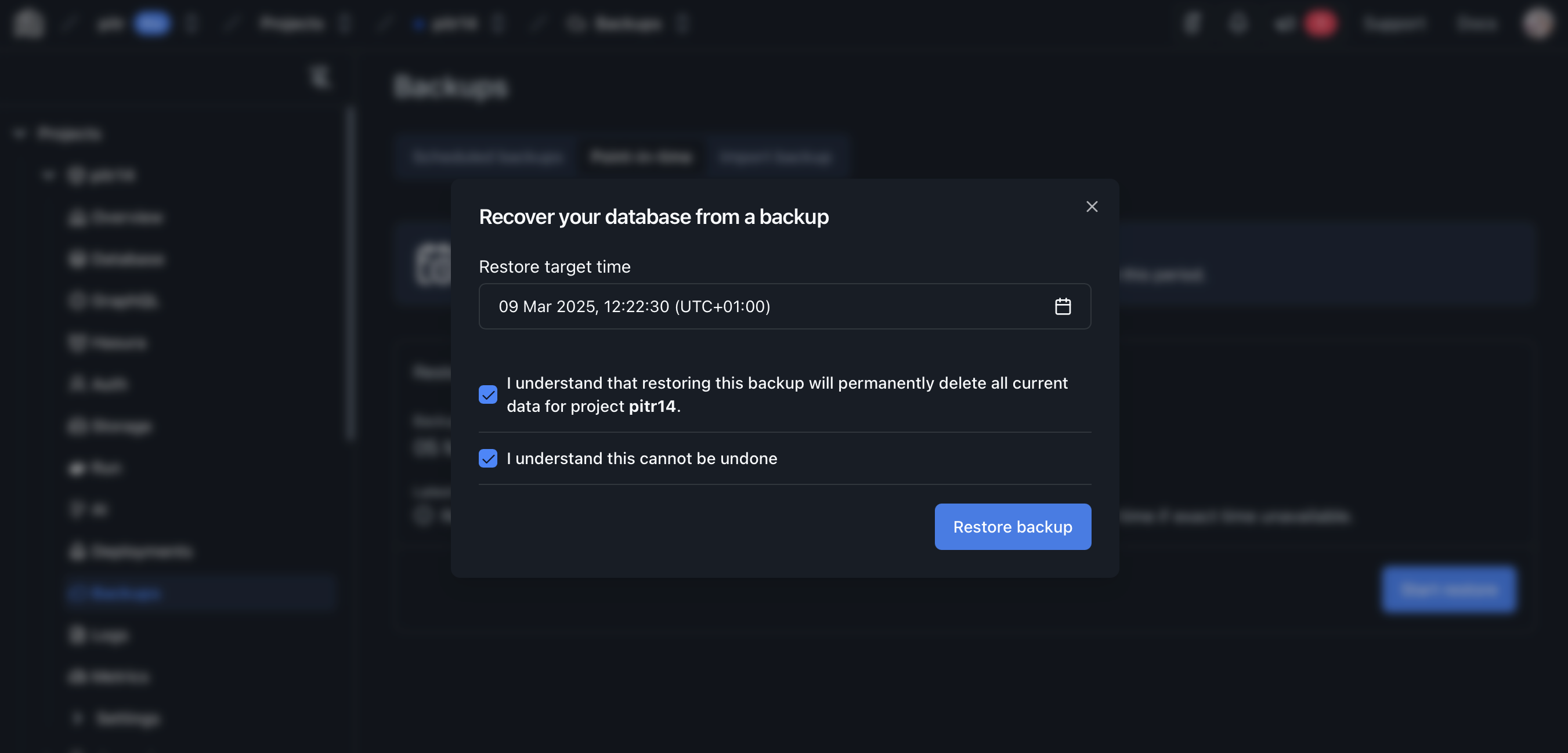
This will trigger the restore in the background, you can now proceed to the logs and filter by “Service: Backup Jobs” to see the progress.
Even though you can specify a point in time down to the second, the actual restore may include data modified after that point in time. This is because we capture changes in segments every 16MB or 5 minutes, whichever occurs first, and the restore needs to execute entire segments to ensure consistency. In some cases postgres may be able to execute the entire segment and revert some changes to get closer to the desired point in time, but this is not guaranteed.
Restoring to a Specific Point in Time on a Different Project
Section titled “Restoring to a Specific Point in Time on a Different Project”You can restore to a specific point in time on a different project in our cloud by following these steps:
Create a new project
Section titled “Create a new project”First, create a new project where we will restore the data into. The project will need to be in the same organization and region as the original project. Before starting the restore make sure the target project is running the same database version as the original project and that you have enough space available for the restore.
Ensure database version is the same
Section titled “Ensure database version is the same”Go to settings -> database in both the new and the original projects and make sure the new project is running the same exact database version as the original project.
Restore backup
Section titled “Restore backup”Finally, go to the new project’s Backups section, navigate to “Import Backup” and select the original project. After this the steps are the same as restoring to a specific point in time on the same project.
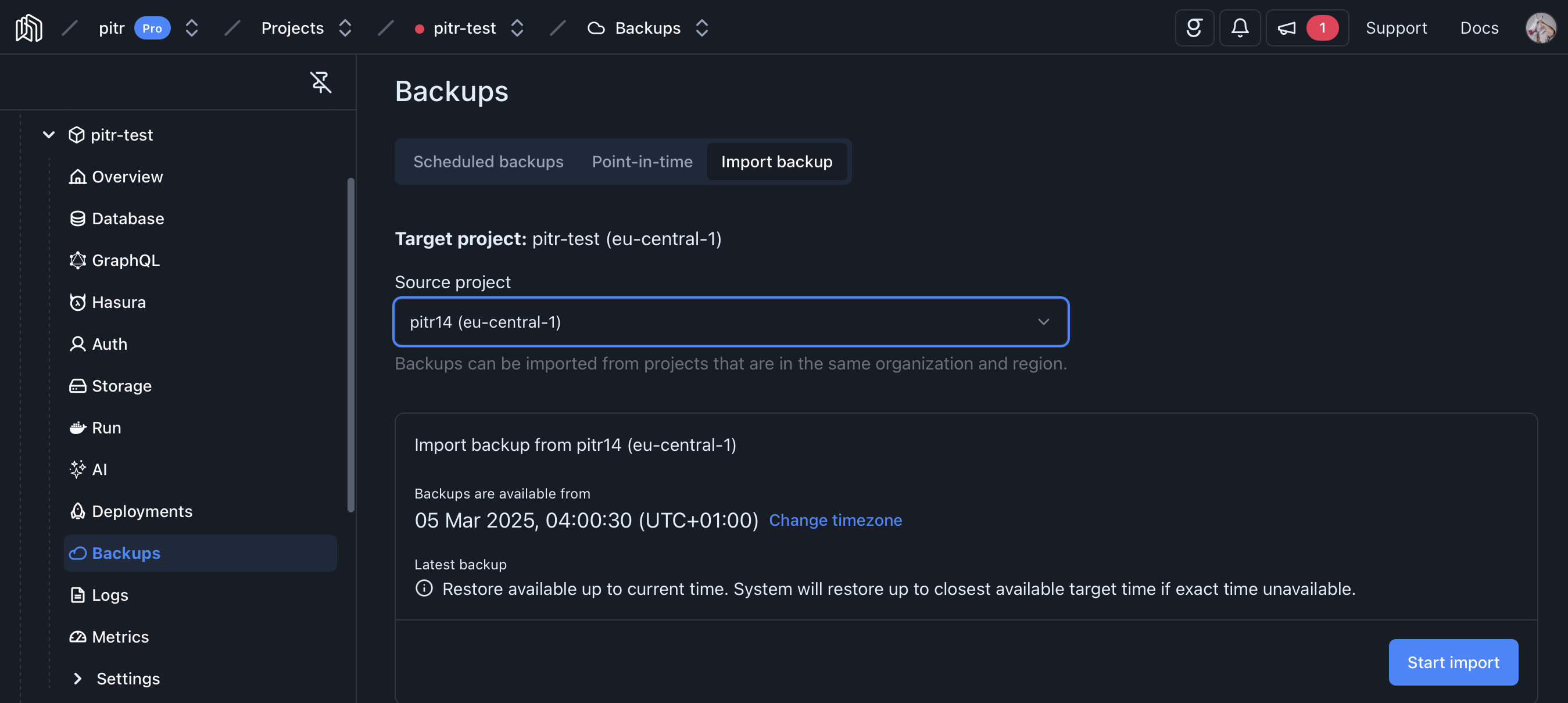
Downloading a Backup
Section titled “Downloading a Backup”Downloading a backup isn’t supported as with Point-in-Time Recovery there is no such thing as a backup that can be downloaded. However, you can restore to a specific point in time on a different project and then use pg_dump to create a backup yourself.